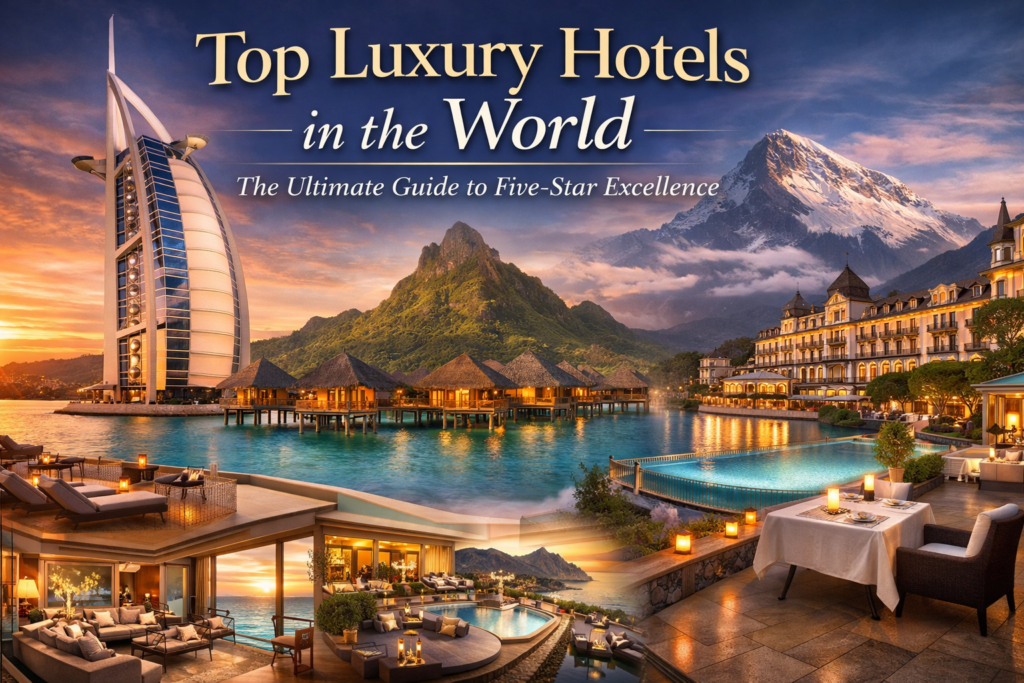
Why Luxury Hotels Still Define Aspirational Travel in 2026
Global tourism demand is still supporting premium travel
Top Luxury Hotels in the World, is not some fading fantasy reserved for glossy magazines. In 2026, it is still one of the clearest symbols of status, comfort, and premium lifestyle spending. That matters for both readers and advertisers, because luxury hotels, premium travel, exclusive resorts, private villas, and five-star hospitality remain high-value commercial keywords that sit right at the intersection of aspiration and purchase intent. UN Tourism reported that international tourist arrivals rose again in 2025, reaching a new post-pandemic record year, while another update noted a 4% increase in international arrivals for 2025 overall. That kind of sustained global demand tells you something simple: people are traveling, and many are willing to pay more for experiences that feel safer, smoother, and more memorable.
What makes that especially interesting is that luxury demand is not being driven by one single type of traveler. It is being fueled by honeymooners hunting for overwater serenity, executives booking world-class city bases, wellness travelers chasing spa-led retreats, and affluent families wanting seamless service without friction. A top-tier hotel is no longer judged only by chandeliers, marble, and thread count. It is judged by how little the guest has to think. The best properties remove stress so smoothly that the stay feels effortless, almost like the hotel has learned to read your mind. That is why the modern luxury hotel market keeps expanding its influence. It is not selling a room. It is selling convenience, privacy, prestige, personalization, and emotional comfort in one of the highest-margin sectors in global travel.
Why affluent travelers keep paying for elite stays
If you have ever wondered why some guests will spend the price of a small car on a weeklong hotel stay, the answer is not just wealth. It is trust. At the ultra-premium level, guests are buying reliability as much as indulgence. They want the airport transfer to work, the suite to look like the photos, the spa therapist to be exceptional, the concierge to solve difficult requests quickly, and the entire environment to feel calm, secure, and deeply polished. In other words, the luxury traveler is often paying to eliminate uncertainty. That is why world’s best hotels, luxury hotel suites, private pool villas, spa resorts, and bespoke concierge service remain such powerful search terms. They signal not just glamour, but reduced risk and higher control.
This is also why the best hotel brands and independent icons continue to invest so aggressively in human service. Forbes Travel Guide says its inspections emphasize service because the way a hotel makes a guest feel is often more memorable than the physical product alone. That idea cuts right to the heart of elite hospitality. A spectacular building may win attention, but refined service wins loyalty. Think of it like owning a luxury watch versus wearing one that has been perfectly fitted, maintained, and matched to your life. The hardware matters, but the experience around it is what makes it unforgettable. That is the true business model of high-end hotels in 2026, and it explains why the sector still commands some of the most lucrative advertising categories in travel, finance, wellness, and lifestyle media.
What Actually Makes a Hotel “Luxury” Today
Service is still the real differentiator
A lot of properties can buy expensive furniture. Fewer can deliver intuitive, high-level service day after day, across every shift, with consistency. That is why serious hotel watchers still treat service as the gold standard. Forbes Travel Guide explains that its anonymous inspectors evaluate properties using up to 900 objective criteria and that service remains central to the rating process. The organization also stresses that inspectors pay their own way and that no one can buy a rating, which matters because credibility is everything in the luxury space. A five-star label only means something if it is earned through a rigorous and independent system.
So what does service look like at the highest level? It looks like remembering preferences without making the guest repeat them. It looks like timing housekeeping around the guest instead of the other way around. It looks like a restaurant team that feels elegant but never stiff, attentive but never intrusive. This is the difference between a beautiful hotel and a truly elite one. Many travelers think luxury means being surrounded by expensive objects, but the real signal is whether the property feels coordinated, personal, and quietly competent at every touchpoint. That is why the best luxury resorts and five-star hotels can charge premium rates year-round. They do not merely create a scene. They create confidence.
Design, privacy, wellness, and personalization now matter just as much
That said, modern luxury is no longer just about white-glove formality. Today’s top properties blend emotional warmth with architectural identity, cultural storytelling, and highly tailored guest experiences. The MICHELIN Guide describes its Key system as a recognition for outstanding stays, and its 2026 explainer defines One Key as a very special stay, Two Keys as an exceptional stay, and Three Keys as an extraordinary stay worth a special journey. That framework is useful because it broadens the conversation beyond old-school star classifications. A modern luxury hotel is not simply expensive. It has to feel singular.
This is why today’s elite hotel conversation increasingly includes wellness retreats, destination spas, architectural design hotels, private butlers, culinary experiences, and exclusive local immersion. A guest might want a panoramic skyline suite in Hong Kong, a riverfront sanctuary in Bangkok, or a secluded Maldivian villa where the concept of time almost melts away. The best hotels understand that luxury now has many dialects. For one traveler, it means a legendary urban address with flawless business amenities. For another, it means a barefoot island retreat with silence, space, and a plunge pool under the stars. Personalization is the new marble lobby. If the stay feels custom-built for the guest, the hotel is speaking the right language.
The Most Trusted Global Signals of Hotel Excellence
Forbes Travel Guide Star Awards
When people search for the best luxury hotels in the world, they often want one simple answer. The truth is a bit more nuanced. There is no single universal ranking system that covers all hotels in all styles with one final scoreboard accepted by everyone. That is why smart readers should look at the strongest signals together. Forbes Travel Guide is one of the most respected because it is an independent rating system built on anonymous inspections. Its 2026 Star Awards describe the organization as operating in 90 countries and rating more than 2,100 hotels, restaurants, spas, and ocean cruises. For hotel consumers, that scale matters. It suggests global breadth, structured methodology, and consistency.
Forbes is especially valuable because it tells travelers something practical: this property has been tested under real guest conditions. That gives the rating an almost audit-like quality. In a market crowded with influencer hype, glossy marketing, and paid brand storytelling, a strong inspection-based award still cuts through the noise. If you are building a shortlist for a truly premium stay, Forbes Travel Guide remains one of the strongest quality filters available. It is not the whole story, but it is one of the clearest signals that the hotel’s standards are not just cosmetic.
The World’s 50 Best Hotels
If Forbes gives you a disciplined inspection mindset, The World’s 50 Best Hotels gives you a global conversation about desirability, buzz, and hospitality excellence at the highest level. The official 2025 list placed Rosewood Hong Kong at No. 1, followed by Four Seasons Bangkok at Chao Phraya River at No. 2 and Capella Bangkok at No. 3. The rest of the top 10 included names like Passalacqua, Raffles Singapore, Atlantis The Royal, Mandarin Oriental Bangkok, Chablé Yucatán, Four Seasons Firenze, and Upper House Hong Kong. That lineup tells a fascinating story: Asia is incredibly strong, classic European icons still carry weight, and the modern luxury guest increasingly values character as much as reputation.
This list is useful because it captures something that inspection systems alone cannot fully express: cultural momentum. A hotel on the rise often reflects shifts in what travelers now want. The 2025 awards also highlighted individual distinctions such as Soneva Fushi for the Art of Hospitality Award, Mandarin Oriental Qianmen, Beijing for Best New Hotel, Desa Potato Head, Bali for Eco Hotel Award, and Atlantis The Royal, Dubai for Best Beach Hotel. Those category signals help readers understand why a hotel is resonating. It may be winning for service, design, sustainability, location, or sheer imagination. That creates a more textured picture of excellence.
MICHELIN Keys
The MICHELIN Key system has quickly become one of the most important new reference points in luxury hospitality. MICHELIN explains that the Key recognizes hotels for outstanding stays, much like Stars recognize outstanding restaurants. Its global hotel selection for 2025 introduced a wide-scale structure for identifying truly exceptional properties, and a 2026 guide noted that among 2,457 Key hotels worldwide, only 143 held the top Three-Key distinction. That scarcity matters because luxury thrives on meaningful curation. The best awards do not just include a lot of names. They separate the remarkable from the merely expensive.
For readers, MICHELIN Keys are especially helpful because they blend prestige with interpretability. One Key suggests a very special stay. Two Keys mean the hotel is exceptional. Three Keys indicate an extraordinary stay worth planning a trip around. That framework is easy to understand, and it aligns closely with how real travelers think. Nobody books a dream hotel because it has a generic label. They book it because the property feels like a destination in itself. MICHELIN’s language captures that emotional logic beautifully. It invites the guest to ask a better question: not just “Is this hotel good?” but “Is this hotel special enough to shape the whole journey?”
A Snapshot of the World’s Standout Luxury Hotels
Asia’s dominance at the top
If one region is setting the pace in luxury hospitality right now, it is Asia. The 2025 World’s 50 Best Hotels ranking put Rosewood Hong Kong in first place, with Four Seasons Bangkok, Capella Bangkok, Raffles Singapore, Mandarin Oriental Bangkok, and Upper House Hong Kong all inside the top 10. That is not a fluke. It reflects a broader truth about luxury travel today: many Asian properties combine remarkable design, legendary service culture, modern wellness, and culinary sophistication in a way that feels incredibly complete.
Why is this happening? In simple terms, many top Asian hotels treat hospitality as both art and operating discipline. They excel in staff training, emotional intelligence, room design, food and beverage integration, and guest privacy. These hotels do not just deliver a nice stay. They orchestrate one. Walking into a leading property in Bangkok, Hong Kong, Singapore, Kyoto, or Bali often feels like stepping into a world where every detail has already been anticipated. That level of refinement turns a stay into a narrative. It is not just about sleeping well. It is about feeling held, understood, and impressed without ever feeling overwhelmed.
Europe, the Middle East, and resort icons still command attention
Asia may be dominating many current lists, but Europe and the Middle East remain towering forces in the luxury hotel market. Passalacqua in Lake Como continues to stand as a symbol of boutique grandeur, while Four Seasons Firenze represents the enduring power of historic European luxury done at a world-class level. In the Middle East, Atlantis The Royal has earned major global attention and was recognized by The World’s 50 Best Hotels 2025 with the Best Beach Hotel award. These properties show how luxury can speak in very different accents. One whispers old-world elegance. Another arrives like a cinematic spectacle. Both can be exceptional.
Then there are destination resorts that almost transcend traditional categories. Soneva Fushi in the Maldives was singled out for hospitality, which says a lot in a market where island luxury is often reduced to scenery alone. A truly top resort has to do more than offer turquoise water and postcard villas. It has to make the whole experience feel seamless, soulful, and deeply human. The same applies to wilderness retreats, desert sanctuaries, and high-design eco escapes. The best properties are not only beautiful. They are narratively strong. They give guests a sense that they have arrived somewhere that could not easily be replicated anywhere else on earth.
Best Luxury Hotels by Experience Type
| Experience Type | Strong Current Examples | Why They Stand Out |
|---|---|---|
| Urban prestige | Rosewood Hong Kong, Upper House Hong Kong, Raffles Singapore | Skyline views, elite dining, business-friendly luxury, refined service |
| Riverfront city luxury | Four Seasons Bangkok, Capella Bangkok, Mandarin Oriental Bangkok | Strong service culture, destination dining, relaxing yet connected settings |
| Heritage grandeur | Passalacqua, Four Seasons Firenze | Historic architecture, romantic atmosphere, classic European prestige |
| Beach and resort glamour | Atlantis The Royal, Soneva Fushi | Resort-scale amenities, privacy, leisure focus, experiential design |
| Design-led emerging icons | Mandarin Oriental Qianmen, Beijing; Desa Potato Head, Bali | Fresh concepts, strong identity, sustainability or innovation appeal |
Urban glamour and skyline prestige
City luxury hotels are for travelers who want energy without chaos. The best ones place guests in a powerful position: close to finance, culture, shopping, and dining, while offering enough calm to recover from the intensity below. Rosewood Hong Kong and Upper House Hong Kong embody this beautifully, albeit in different ways. One leans into large-scale prestige and polished grandeur. The other is often praised for a more serene, understated, design-forward style. Both belong to the same elite universe: places where the room is not just accommodation but a private command center above the city.
That urban luxury model is extremely attractive for affluent business travelers and premium leisure guests because it combines efficiency with indulgence. You can finish meetings, step into a world-class spa, dine at a destination restaurant, and watch a skyline glitter from your suite, all in one day. It is the hospitality version of a tailored suit with hidden technical fabric: elegant on the surface, highly functional underneath. That is why urban icons remain some of the most commercially important luxury properties in the world.
Beach, island, and nature-driven seclusion
Not every luxury traveler wants energy. Many want the opposite. They want quiet, space, salt air, and the feeling that the world has stopped asking anything of them. That is where island resorts, beach properties, and nature-driven sanctuaries thrive. Soneva Fushi is a prime example of how the luxury conversation has evolved. It is not just about visible opulence. It is about environment, barefoot ease, high-touch hospitality, and a sense of escape that feels rare in a hyperconnected age.
This matters because some of the most valuable luxury keywords today are tied to restoration: wellness retreat, private island resort, luxury spa hotel, overwater villa, eco luxury resort, and honeymoon hotel. Those phrases align with a deep consumer desire to turn travel into recovery. The best nature-led properties understand that true luxury sometimes means subtraction rather than addition. Fewer notifications. Fewer crowds. Fewer decisions. More stillness. More privacy. More sensory beauty. When a hotel can deliver that without sacrificing service quality, it becomes almost impossible to forget.
Heritage grandeur and timeless classic luxury
There is still something uniquely magnetic about hotels that carry history in their walls. A grand European villa, a legendary palace-style property, or a heritage landmark hotel can offer a type of emotional richness that newer builds sometimes struggle to match. Passalacqua and Four Seasons Firenze sit comfortably inside that timeless tradition. Their appeal is not just luxury in the modern sense. It is continuity, atmosphere, craftsmanship, and a sense that the guest is entering a place with memory and identity already intact.
For many travelers, that is the purest version of five-star excellence. It feels less transactional and more cinematic. You are not simply checking in. You are stepping into a setting that already knows how to be extraordinary. The best heritage hotels balance that history with modern expectations: superb mattresses, advanced wellness, sharp dining, discreet technology, and impeccable service. Get that balance right, and the result is powerful. It is like hearing a classical piece performed with modern precision. The soul remains old, but the experience feels perfectly alive.
How to Choose the Right Five-Star Hotel for Your Style
Couples, families, business travelers, and wellness seekers
The smartest way to choose among the top luxury hotels in the world is not to ask which one is objectively best. Ask which one is best for your trip. A honeymoon couple may care about privacy, romance, views, and villa design. A family may need suite flexibility, kids’ programming, dining range, and logistics that do not collapse under pressure. A business traveler may prioritize airport access, executive service, elite dining, and flawless sleep quality. A wellness-focused guest may care more about spa philosophy, nutrition, movement programming, and quiet. The point is simple: luxury is contextual.
This is where rankings help, but self-awareness helps more. Think of the hotel as the frame around your trip. If the frame fits, the whole picture looks better. If it does not, even a famous property can feel wrong. Some travelers chase labels when they should be chasing fit. A world-famous resort may be stunning, but if you want walkable culture and evening energy, a remote villa can feel isolating. A legendary city hotel may be exceptional, but if you want barefoot peace, it may be the wrong script entirely. The best booking strategy always starts with traveler identity, not just hotel reputation.
Location, seasonality, and value strategy
Luxury value is not always about paying less. It is often about paying at the right time for the right room in the right destination. Seasonality can completely reshape a high-end booking. Peak festive periods, school holidays, and destination events can send rates soaring, while shoulder seasons often preserve much of the experience at significantly better value. Forbes Travel Guide also notes on property pages that rates can vary widely by room type and season, which is a useful reminder that luxury pricing is highly dynamic.
A smart traveler treats luxury booking like portfolio allocation. Do not spend blindly across every line item. Decide what matters most. Maybe the suite matters more than the flight. Maybe the destination matters more than the exact brand. Maybe one iconic splurge night is more memorable than four expensive but forgettable nights. Many premium travelers get better outcomes by mixing one flagship stay with one slightly softer-priced property in the same journey. The goal is not simply to spend more. It is to direct money toward the parts of the experience that will produce the strongest emotional return.
What to Expect From Pricing, Value, and Booking Strategy
Why rates vary so much at the top end
People often assume that all luxury hotels operate in roughly the same price band. They do not. Rates can differ dramatically based on destination, room category, view, villa size, included services, demand calendar, and brand position. A prestigious city room may cost less than a private pool villa at a top island resort, yet the city hotel may still feel more “luxury” to a certain kind of traveler because of its service density and urban prestige. In other words, price and perceived value do not always move in parallel.
This is why travelers should compare hotels by experience architecture, not just nightly cost. What is actually included? Is breakfast meaningful or symbolic? Are transfers, wellness sessions, butler service, or club access built into the rate? Does the property offer enough on-site quality to justify staying in, or will you be spending heavily outside the hotel anyway? Luxury pricing is like comparing fine dining tasting menus. The number on the bill matters, but the composition of the experience matters more. Once you understand that, hotel selection becomes much more strategic.
How smart travelers maximize luxury without wasting money
The best luxury booking habits are surprisingly disciplined. Book early for iconic properties with limited inventory. Watch shoulder seasons for flagship destinations. Prioritize room categories carefully, since the leap from a base room to a high-value upgraded category can sometimes transform the entire stay. Use trusted advisors or official preferred programs when they offer meaningful perks like breakfast, upgrades, or property credits. Those extras can materially change value without cheapening the experience.
Most importantly, pay for what you will genuinely use. Travelers are often seduced by marketing language and oversized rooms they do not need. Real value comes from alignment. A smaller but beautifully designed suite in the right hotel can outperform a huge room in a property that does not match your travel style. The top five-star hotels do not just charge for size. They charge for confidence, atmosphere, and smoothness. When you understand that, you stop shopping like a bargain hunter and start booking like an informed luxury consumer.
Conclusion
The world’s top luxury hotels are not simply the most expensive addresses on the map. They are the properties that consistently deliver rare combinations of service excellence, design quality, privacy, wellness, culinary strength, and emotional intelligence. Current global signals support that view. Forbes Travel Guide’s 2026 awards continue to emphasize rigorous inspection and service-led standards, The World’s 50 Best Hotels 2025 shows strong momentum behind standout properties in Asia and beyond, and the MICHELIN Key system adds a fresh, highly readable framework for identifying extraordinary stays.
So, which are the best luxury hotels in the world right now? The most honest answer is that the leaders depend on what kind of excellence you value most. If you want globally celebrated city prestige, names like Rosewood Hong Kong, Four Seasons Bangkok, Capella Bangkok, Raffles Singapore, and Upper House Hong Kong are impossible to ignore. If you want romantic European grandeur, Passalacqua and Four Seasons Firenze remain powerful benchmarks. If you want destination resort impact, Soneva Fushi and Atlantis The Royal represent two very different but equally compelling visions of modern indulgence. The smartest traveler does not chase hype alone. They match the hotel to the purpose of the trip, and that is where true five-star excellence begins.
FAQs
Which hotel is considered the best in the world right now?
Based on The World’s 50 Best Hotels 2025, Rosewood Hong Kong held the No. 1 position. That said, “best” depends on the methodology. Forbes Travel Guide and MICHELIN Keys evaluate excellence differently, so travelers should compare multiple trusted sources.
What is the difference between five-star hotels and luxury hotels?
A five-star hotel usually refers to a formal classification or elite service level, while a luxury hotel is a broader concept that includes design, exclusivity, personalization, wellness, dining, and emotional quality. Some luxury hotels feel more special than standard five-star properties because they deliver a more distinctive overall stay.
Are MICHELIN Keys and Forbes Stars the same thing?
No. Forbes Travel Guide Stars come from an inspection-based rating system with anonymous visits and detailed criteria, while MICHELIN Keys recognize outstanding stays through MICHELIN’s hotel framework. Both are respected, but they serve slightly different evaluative purposes.
Which regions dominate luxury hospitality today?
Asia is especially strong right now, with Hong Kong, Bangkok, Singapore, Beijing, and Bali all appearing prominently in current hotel conversations and awards. Europe and the Middle East also remain major luxury leaders, particularly for heritage properties and large-scale resort glamour.
How far in advance should luxury hotels be booked?
For iconic hotels in peak season, booking several months ahead is wise, and for festive periods or limited-inventory villas, even earlier can be smart. High-end rates and availability can shift sharply by season, room type, and destination demand.