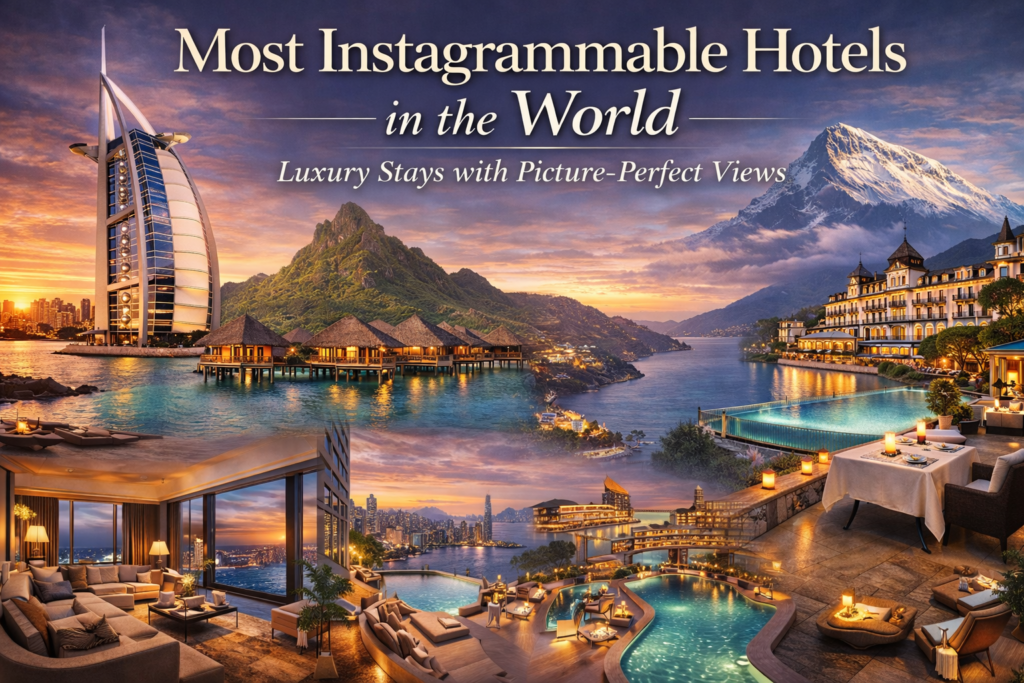
Why Instagrammable Hotels Matter More Than Ever in 2026
Most Instagrammable Hotels in the World, the phrase Instagrammable hotel might sound trendy, but in 2026 it describes something very real in the luxury travel market: visual desirability has become a booking driver. Travelers are no longer choosing hotels only for location, service, or room size. They are also choosing them for panoramic views, iconic interiors, infinity pools, private villas, designer suites, and photo-ready spaces that make an entire trip feel elevated before the first dinner reservation is even made. That shift matters because premium hospitality now lives at the intersection of experience, identity, and online storytelling. A luxury hotel with a dramatic skyline backdrop or a flawless oceanfront terrace does not just sell nights; it sells content, status, memory, and emotional impact.
That trend is unfolding inside a still-strong global travel market. UN Tourism reported that international tourist arrivals rose 4% in 2025, reaching an estimated 1.52 billion, which shows that global demand for travel remains resilient. When travel stays strong and premium consumers keep spending, luxury hotels, five-star resorts, bucket-list destinations, honeymoon stays, and high-end travel experiences become even more commercially valuable content categories. In simple terms, people are still moving, still dreaming, and still paying for experiences that look and feel exceptional. That is exactly why the world’s most photogenic hotels are more than a social media topic. They are one of the clearest mirrors of what modern luxury travel has become.
What Makes a Hotel Truly Instagrammable
A genuinely Instagrammable hotel is not just a pretty building with a nice pool. It is a property where architecture, interior design, natural light, scenery, and guest experience work together like a perfectly coordinated fashion shoot. Some hotels win because they frame a skyline so well that every window looks cinematic. Others win because they sit on a cliff, lagoon, river, or private island where the surroundings do half the storytelling. The best ones do both. They create a setting that feels visually complete from every angle, whether the guest is taking a sunrise coffee shot, a dinner terrace photo, or a relaxed room view with no filter at all.
That is where the concept becomes more sophisticated than simple beauty. The most Instagrammable luxury hotels are also highly intentional spaces. They understand proportion, mood, texture, and atmosphere. A marble bathroom with soft natural light, a terrace pool curving toward the horizon, or a suite that frames a city skyline like a living postcard can be more memorable than any hotel slogan. Visual design has become part of hospitality strategy, and that is one reason these properties perform so well in search categories such as luxury hotels with views, best rooftop hotel pools, most beautiful hotels in the world, and picture-perfect resorts. A hotel that photographs beautifully often feels emotionally stronger in person too, because it has already mastered the art of making moments look special.
The Rankings and Signals Shaping Hotel Prestige Right Now
When travelers search for the most Instagrammable hotels in the world, they often want a list that feels both stylish and credible. The strongest current starting point is The World’s 50 Best Hotels 2025, whose official list placed Rosewood Hong Kong at No. 1, followed by Four Seasons Bangkok at Chao Phraya River at No. 2, Capella Bangkok at No. 3, Passalacqua at No. 4, Raffles Singapore at No. 5, and Atlantis The Royal at No. 6. The top 10 also included Mandarin Oriental Bangkok, Chablé Yucatán, Four Seasons Firenze, and Upper House Hong Kong. That lineup is useful because it captures properties that are not just luxurious, but visually powerful, culturally relevant, and globally admired.
Another important signal comes from Forbes Travel Guide 2026, which describes itself as the only independent global rating system for luxury hotels, restaurants, spas, and ocean cruises. Forbes says its inspectors evaluate properties using up to 900 objective criteria and that service remains central to the process. That matters for a topic like Instagrammable hotels because the strongest properties are not simply photogenic. They also deliver genuine quality behind the images. A hotel can look spectacular on social media and still disappoint in real life. Inspection-based recognition helps separate pure aesthetics from real five-star substance.
The MICHELIN Guide adds another layer through its hotel recognition system, the MICHELIN Key, which identifies standout stays across its hotel selection. MICHELIN’s own explanation emphasizes that Keys mark very special, exceptional, or extraordinary stays, depending on the level awarded. That framework is especially relevant for aspirational travel content because travelers do not only want a hotel that looks good in one photo. They want a hotel worth planning a trip around.
Asia Is Dominating the Visual Luxury Conversation
If one region currently defines the Instagrammable luxury hotel aesthetic, it is Asia. That is not just a matter of reputation; the major rankings show it clearly. Rosewood Hong Kong, Four Seasons Bangkok, Capella Bangkok, Raffles Singapore, Mandarin Oriental Bangkok, and Upper House Hong Kong all sit prominently in The World’s 50 Best Hotels 2025. That concentration says a lot. Asia is excelling at the precise mix that visual travelers love: dramatic views, polished interiors, refined service culture, and strong location storytelling.
Take Rosewood Hong Kong as an example. A top-ranked urban luxury hotel in one of the world’s most photogenic harbors almost automatically becomes a visual icon, but its appeal goes deeper than skyline glamour. Hotels like this work because they make scale feel intimate. They turn giant city energy into something luxurious and personal. The same is true in Bangkok, where the city’s top riverfront hotels are leveraging water, architecture, and warm hospitality to create images that feel both elegant and relaxed. In a way, these hotels are doing what great filmmakers do: using lighting, framing, and setting to make the viewer feel something before a single word is spoken. That is the secret behind modern Instagrammable luxury.
Europe Still Owns Timeless Romantic Hotel Imagery
While Asia is leading many contemporary rankings, Europe remains unmatched when it comes to classical visual romance. Passalacqua on Lake Como and Four Seasons Firenze in Florence show why the continent still dominates the fantasy side of luxury travel. Their appeal is not based on futuristic spectacle or hyper-modern scale. It is rooted in atmosphere, history, gardens, old-world proportions, and the kind of visual softness that makes every frame feel cinematic. These are hotels where the staircase, the terrace, the breakfast setting, and the late-afternoon light all seem to have been arranged by a stylist who understands longing.
That timeless appeal matters because a large part of Instagrammable travel is emotional, not just aesthetic. Travelers are not only posting beautiful pictures. They are posting symbols of escape, romance, elegance, and personal aspiration. A historic Italian villa or Florentine palace hotel sends a different message from a glass-wrapped city tower, even if both are luxurious. One says refinement and heritage. The other says energy and modern sophistication. Neither is better in absolute terms. They simply serve different fantasies. That is why romantic luxury hotels, historic five-star hotels, Lake Como luxury stays, and most beautiful European hotels remain so powerful in both search and social media.
The Middle East and Resort Destinations Deliver High-Impact Visual Drama
If Europe offers romantic softness, the Middle East often offers visual drama at full volume. Atlantis The Royal in Dubai, ranked No. 6 in The World’s 50 Best Hotels 2025 and recognized there as the Best Beach Hotel 2025, represents the bold end of the Instagrammable hotel spectrum. This is the kind of property built to stop people mid-scroll. It is glamorous, high-scale, contemporary, and openly theatrical. That makes it a natural fit for travelers who want their stay to feel larger than life.
Resort destinations such as the Maldives and parts of Mexico also play a huge role in the picture-perfect hotel conversation. Soneva Fushi was highlighted by The World’s 50 Best Hotels with the Art of Hospitality Award 2025, while Chablé Yucatán made the top 10 overall. These properties show that visual appeal does not always have to be loud. In some cases, the strongest hotel images come from stillness: a villa above turquoise water, a private plunge pool disappearing into jungle greenery, or a spa pavilion where the setting feels almost dreamlike. The best resort photography works like a whisper instead of a shout. It makes the viewer lean closer.
What Travelers Really Want from Picture-Perfect Luxury Hotels
The modern guest is more visually literate than ever. People know the difference between a genuinely beautiful property and one that simply photographs well from a single angle. That means the world’s most Instagrammable hotels have to satisfy a higher standard. Guests want authentic design, premium amenities, wellness experiences, private dining, signature suites, and views that feel spectacular without looking staged. They want the hotel to be photogenic because it is truly exceptional, not because the marketing team found one flattering corner.
This is why the best visual hotels often perform strongly across multiple recognition systems. They have the looks, but they also have the details. Forbes Travel Guide’s emphasis on inspection and service helps explain why certain properties keep rising. As the organization puts it, “We verify luxury.” That short line captures a big truth in high-end travel. Real luxury cannot rely on a camera angle alone. It has to hold up under scrutiny, over multiple nights, and across every guest touchpoint. For visual-first travelers, that is actually good news. It means the best Instagrammable hotels are increasingly becoming the best hotels overall, not just the most photogenic.
Best Types of Instagrammable Hotels by Experience
| Experience Type | Strong Current Examples | Why They Photograph So Well |
|---|---|---|
| Skyline luxury hotels | Rosewood Hong Kong, Upper House Hong Kong | Panoramic city views, sleek interiors, dramatic night shots |
| Riverfront urban retreats | Four Seasons Bangkok, Capella Bangkok, Mandarin Oriental Bangkok | Water reflections, serene terraces, elegant daylight scenes |
| Historic European icons | Passalacqua, Four Seasons Firenze, Raffles Singapore | Heritage architecture, gardens, classic romance, timeless symmetry |
| Spectacle-driven beach glamour | Atlantis The Royal | Bold modern design, grand pools, beachfront visual impact |
| Nature-led luxury resorts | Chablé Yucatán, Soneva Fushi | Organic materials, immersive landscapes, calm luxury framing |
The table shows that Instagrammable appeal is not one fixed style. Some hotels are made for golden-hour city shots. Some are made for candlelit terrace images and architectural symmetry. Others are defined by landscape integration, where the property seems to disappear into jungle, sea, or sky. That diversity is part of why this topic performs so well in search. Someone typing best Instagram hotels in Asia is imagining a different visual outcome from someone typing most romantic hotels in Europe or luxury resorts with ocean views.
The real lesson is that the best hotels understand their own camera language. They know whether their strength is scale, softness, geometry, nature, or intimacy. A great hotel does not try to be every kind of beautiful. It chooses a visual identity and executes it thoroughly. That is what makes the images feel effortless instead of overproduced.
How to Choose the Right Instagrammable Hotel for Your Travel Style
Choosing the right picture-perfect hotel starts with honesty. Are you looking for romance, energy, privacy, prestige, or pure scenery? A honeymooner may want a resort where every corner feels intimate and slow, with sunset decks, private pools, and warm-toned interiors. A content-focused city traveler may prefer a high-rise suite with floor-to-ceiling windows, rooftop drinks, and a skyline that changes personality from day to night. A wellness traveler may want muted design, gardens, spa rituals, and enough visual calm to make the entire stay feel restorative. The important thing is not to chase a generic “best.” It is to chase the version of beauty that matches your trip.
This matters because a hotel is not just a backdrop. It becomes part of the emotional structure of the journey. The wrong Instagrammable hotel can still look great in photos while feeling mismatched in real life. A high-energy Dubai icon might overwhelm someone seeking quiet recovery. A minimalist retreat might feel too subdued for someone wanting glamorous celebration content. The best bookings happen when visual identity and traveler identity line up. Think of it like choosing the right outfit for an important event. The best one is not automatically the most expensive or most photographed. It is the one that feels right on you.
Why These Hotels Are So Valuable for Premium Travel SEO
From an SEO perspective, this subject is especially powerful because it sits inside multiple high-value intent categories at once. Readers searching for the most Instagrammable hotels in the world are not just browsing casually. Many are researching destinations, comparing premium stays, planning honeymoons, building wish lists, or looking for bookable luxury experiences. That means the topic naturally overlaps with advertiser-friendly keyword clusters such as luxury travel, high-end hospitality, honeymoon resorts, private villas, premium credit cards, travel insurance, international flights, and exclusive vacation packages.
There is also strong built-in engagement. Unlike dry travel topics, Instagrammable hotel content invites emotion, fantasy, and comparison. It gives readers something to imagine themselves inside. That keeps them reading longer, clicking more, and interacting more deeply with the content. In practical publishing terms, that is gold. Articles like this work because they are useful, aspirational, and commercially aligned at the same time. They attract readers who are already halfway to a purchase mindset. In the premium travel world, that is exactly the kind of traffic brands want.
Conclusion
The world’s most Instagrammable hotels in 2026 are not just places to stay. They are visual experiences designed to shape memory, mood, and aspiration. Current hotel rankings show that the strongest names include Rosewood Hong Kong, Four Seasons Bangkok, Capella Bangkok, Passalacqua, Raffles Singapore, Atlantis The Royal, Chablé Yucatán, Four Seasons Firenze, and Upper House Hong Kong, while broader recognition from Forbes Travel Guide and MICHELIN reinforces the importance of quality behind the image.
The smartest way to approach these hotels is to stop thinking only in terms of popularity and start thinking in terms of fit. Do you want skyline sophistication, riverfront calm, historic romance, beach spectacle, or barefoot nature luxury? Each style creates a different kind of picture-perfect stay. The best Instagrammable hotel is not simply the one that looks extraordinary online. It is the one that makes your real-life experience feel just as extraordinary when the phone is finally put down.
FAQs
1. Which hotel is ranked No. 1 in The World’s 50 Best Hotels 2025?
Rosewood Hong Kong holds the No. 1 spot on the official The World’s 50 Best Hotels 2025 list.
2. Are Instagrammable hotels always luxury hotels?
Not always, but the most globally famous Instagrammable hotels are often luxury properties because design, setting, and service all contribute to visual impact.
3. Which regions dominate the Instagrammable hotel market right now?
Asia is especially strong in current rankings, while Europe, the Middle East, and top resort destinations remain major players.
4. What does Forbes Travel Guide evaluate in hotels?
Forbes Travel Guide says its inspectors use up to 900 objective criteria, with service remaining central to its ratings.
5. Why are these hotels so popular on social media?
They combine luxury design, beautiful views, distinctive architecture, and emotionally strong travel settings that turn ordinary moments into high-impact visual content.