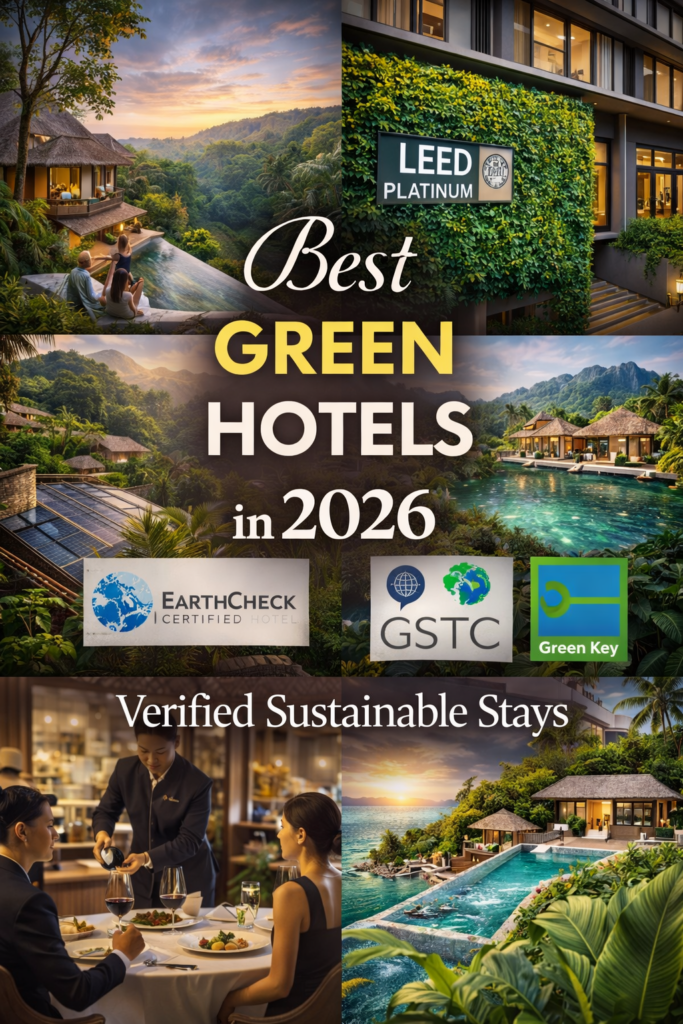
Best Green Hotels in 2026, luxury travel in 2026 has a new flex, and it’s not just marble bathrooms or rooftop pools. It’s verified sustainability—the kind that’s audited, measured, and proven, not just written on a cute little card asking you to reuse towels.
Because let’s be real: anyone can say “eco-friendly.” A truly green hotel in 2026 backs it up with third-party certifications, transparent standards, and measurable performance—energy, water, waste, and community impact. That’s why this guide is about verified sustainable stays, not vague “we love the planet” marketing.
If you’re searching for best green hotels 2026, eco luxury resorts, sustainable 5-star hotels, verified eco hotels, or carbon-conscious travel, this is your playbook—built around the certifications that actually mean something, plus a shortlist of properties and brands with clear, verifiable sustainability signals.
What “Green Hotel” Really Means in 2026
Sustainability vs greenwashing in luxury hospitality
Best Green Hotels in 2026, a “green hotel” is not automatically green because it has bamboo straws and a recycling bin. In 2026, the best sustainable hotels act more like high-performance systems:
- They measure energy and water use.
- They reduce waste and emissions.
- They audit practices with external standards.
- They support local communities and responsible labor.
If the hotel can’t explain what it tracks and what it improved, it’s probably running on vibes.
Why “verified” matters more than vibes
Verification matters because sustainability claims are easy to fake and hard to audit as a guest. Third-party programs exist to do the heavy lifting—standards, criteria, inspections, evidence checks, and ongoing improvement.
The most useful approach is simple: trust the receipts, not the slogans.
The Top Certifications That Actually Prove Sustainability
Here are the sustainability badges that carry real weight in 2026 because they’re tied to clear standards and external evaluation.
GSTC and GSTC-accredited certification bodies
The Global Sustainable Tourism Council (GSTC) publishes globally recognized sustainability standards for travel and tourism and positions them as a common “language” for sustainability.
The four pillars behind GSTC standards
GSTC’s standards are commonly framed across four pillars (high-level themes): effective sustainability management, socio-economic benefits, cultural heritage, and environmental impacts.
Also important: GSTC’s role is not “they personally certify every hotel.” They provide criteria and assurance, including accreditation of certification bodies that audit hotels.
Green Key eco-label
Green Key is a widely used eco-label in tourism and highlights strict criteria set by the Foundation for Environmental Education.
What Green Key criteria cover
Green Key publishes criteria across multiple areas (for hotels/hostels and other categories), emphasizing high environmental requirements.
And Green Key also notes its scale—thousands of certified establishments across many countries—which matters because it’s not a niche badge.
EarthCheck certification
EarthCheck is known for science-backed, metrics-based verification, often focusing on measurable performance areas like energy, emissions, water, waste, and community impact.
Metrics-based verification
If a hotel talks about benchmarks and tracked indicators (not just “we care”), EarthCheck-style certification language is often what that looks like.
LEED for hotels
LEED is a green building certification framework used for designing and operating hotels sustainably, and USGBC highlights meaningful efficiency outcomes (energy, water, waste, and emissions reductions) associated with green buildings.
Building performance matters
LEED is especially strong as proof of building design and operational efficiency—a big deal because a hotel’s footprint is heavily influenced by the building itself, not just daily housekeeping policies.
The “Verified Green Stay” Scorecard for 2026
Want a practical way to judge any hotel in 60 seconds? Use this scorecard. A truly sustainable hotel in 2026 usually performs across all five—not just one.
Energy and carbon
Look for:
- renewable energy programs
- energy efficiency tracking
- decarbonization goals
- reporting (even partial)
If a hotel can’t describe how it reduces energy use, the sustainability story is incomplete.
Water and waste
Sustainable hotels tend to have:
- water reduction programs (laundry, landscaping, fixtures)
- waste separation + reduction
- food waste systems
- plastic reduction beyond “no straws”
EarthCheck-style programs emphasize measuring water efficiency and waste reduction as core indicators.
Chemicals, indoor air, and healthy rooms
This is the “hidden luxury” factor: indoor air quality, responsible cleaning products, healthier materials, fewer irritants. LEED, for example, frames sustainability as part of designing healthier, more efficient buildings.
Local sourcing and community impact
A green hotel isn’t just about the environment. It’s also about:
- local purchasing
- fair labor practices
- community partnerships
- cultural respect
GSTC criteria frameworks explicitly include social and cultural considerations, not only environmental ones.
Transparency and audits
The best sign: third-party verification. Look for certification logos that link to real standards, real criteria, and real auditing.
Best Green Hotels in 2026
These picks are here because they have clear “verified” signals—certification announcements, brand-level audits by accredited bodies, or widely recognized building standards.
Six Senses — audited sustainability with a GSTC-accredited certification body
Six Senses (part of IHG) announced that multiple Six Senses properties were certified by Control Union, a certification body accredited by GSTC, after extensive audits on sustainability planning and community impact.
For travelers, this is one of the cleanest “verified luxury sustainability” signals: external audit + accredited framework.
If you want eco luxury resorts that still feel indulgent—spa culture, privacy, and high design—Six Senses is a strong 2026 sustainability shortlist brand.
The Apurva Kempinski Bali — GSTC-certified and EarthCheck-recognized
The Apurva Kempinski Bali’s official press materials describe it as Indonesia’s first GSTC-certified hotel, and also note EarthCheck achievements.
EarthCheck has also published sustainability-related coverage about the resort’s initiatives.
For a traveler, this is the “triple win”:
- a luxury resort product
- a clear certification claim with GSTC framing
- and an established sustainability certification ecosystem
If your 2026 keyword is sustainable luxury resort Bali, this is the type of verification trail you want.
Four Seasons Resort Chiang Mai — Green Key certified
Four Seasons Resort Chiang Mai announced it received the Green Key Certificate, tying the recognition to Green Key’s criteria and the Foundation for Environmental Education.
This is a strong pick for travelers who want:
- luxury hospitality consistency
- nature-forward setting
- a recognized eco-label
Four Seasons Hotel Doha — Green Key certified
Four Seasons Hotel Doha also announced it received Green Key certification for sustainability commitment.
For eco-conscious business travel and premium Gulf stays, that’s a clean “verified” signal.
Four Seasons Montreal — Green Key Global certified
Four Seasons Montreal is presented as a Green Key Global-certified property in Green Key Global resources.
If you’re hunting for green city hotels 2026, urban properties with clear certification claims are especially valuable because city hotels can have major operational footprints.
Six Senses Vana (India) — LEED Platinum
Six Senses highlights a property in India that achieved LEED Platinum, emphasizing environmental design standards.
For wellness travel in 2026, LEED Platinum + a sustainability-driven hospitality brand is a very advertiser-friendly combination (wellness, premium lifestyle, sustainability, high-spend guests).
Best Green Hotels by Traveler Type
Best for luxury wellness
Look for brands that treat sustainability as part of wellbeing—healthy buildings, less chemical load, stronger air quality, and nature integration. LEED-oriented properties and wellness-forward hotel groups tend to win here.
Best for eco-luxury beach escapes
For beachfront eco-luxury, the sweet spot is a resort with:
- verified certification (GSTC, EarthCheck, Green Key)
- local sourcing
- reef and biodiversity responsibility
- serious water management
The Apurva Kempinski Bali’s certification claims make it an example of a beach luxury resort that’s trying to “prove it,” not just say it.
Best for city stays with verified standards
City travelers should prioritize:
- recognized eco-labels
- building efficiency standards (LEED)
- transparent operations
That’s why certified city properties like Four Seasons Montreal matter in a “best green hotels” conversation.
Best for quiet luxury and privacy
Eco-luxury travelers often want privacy (villas, suites, calm design) plus values alignment. Brand-level certification and audited standards, like Six Senses’ GSTC-accredited certification process, are strong signals here.
How to Book Verified Sustainable Hotels in 2026 Without Getting Fooled
The 60-second verification checklist
When you’re about to book, do this:
- Look for a specific certification name (not “eco-friendly”)
- Find the criteria page (Green Key criteria, GSTC standards)
- Check whether certification implies audits/verification
- Look for recent certification announcements (not 8 years ago)
- Confirm the claim is on an official brand page or recognized body
Red flags that scream greenwashing
- only towel reuse messaging
- no third-party standards mentioned
- vague “we are sustainable” with no metrics
- “eco” claims that don’t include water/energy/waste details
Even general travel guidance notes that third-party certifications (LEED, Green Key, EarthCheck) are key and advises avoiding purely claim-based “green” messaging.
What to ask the hotel
Ask these three questions:
- “Which third-party sustainability certification do you currently hold, and when was it last renewed?”
- “Do you publish annual sustainability metrics (energy, water, waste) or a sustainability report?”
- “What are your top two measurable sustainability improvements from the last 12 months?”
If they can answer cleanly, you’re dealing with a real program, not PR perfume.
2026 Trends in Sustainable Hospitality
Certification is becoming a luxury requirement
Sustainability certifications are turning into the new luxury trust marker—like “five-star service,” but for operations and impact. Green Key’s scale and structured criteria show why this is becoming mainstream.
Sustainable meetings and corporate travel demand
Corporate travel is pressuring hotels to prove sustainability in measurable ways, especially for events and meetings. Industry coverage of hotel groups scaling sustainable meeting programs shows how demand is shifting from “nice-to-have” to “must-have.”
New sustainable hotels opening in 2026
There are also “new sustainable hotels” being discussed for 2026 travel planning. For example, Virtuoso published a recent roundup of new sustainable hotels to check into in 2026.
Just note: “new and sustainable” doesn’t always mean “already certified,” so treat openings as promising leads until certifications are confirmed.
Conclusion
The best green hotels in 2026 aren’t the ones with the loudest eco slogans—they’re the ones with verified sustainable stays backed by real standards, real criteria, and real audits. Programs and frameworks like GSTC standards, Green Key, EarthCheck, and LEED create a practical way to separate true sustainability from greenwashing. On the hotel side, verified signals like Six Senses’ certification through a GSTC-accredited body, The Apurva Kempinski Bali’s GSTC certification claims, and Green Key–certified Four Seasons properties are the kind of proof-driven indicators eco-luxury travelers should prioritize in 2026.
Book with receipts. Your trip will feel better—and your “I want luxury, but I also want values” brain will finally relax.
FAQs
1) What is the most trusted sustainability standard for hotels?
There isn’t one single “best,” but GSTC standards are widely used as global sustainability criteria and as a foundation for certification bodies that audit hotels.
2) Is Green Key certification legit for hotels?
Green Key is a recognized eco-label with published criteria and a large global network of certified establishments, which makes it a strong verification signal.
3) What does EarthCheck certification actually measure?
EarthCheck describes its certification as independently verifying environmental and social performance using metrics like energy use, emissions, water efficiency, waste reduction, and community impact.
4) Does LEED mean a hotel is sustainable?
LEED is primarily a green building certification framework that supports efficient, lower-impact building design and operations. It’s a strong signal for building performance, but you may still want to see operational sustainability practices too.
5) How can I quickly verify a hotel is truly eco-friendly?
Look for third-party certifications (like LEED, Green Key, EarthCheck) and avoid hotels that only make generic “green” claims without proof or criteria links.