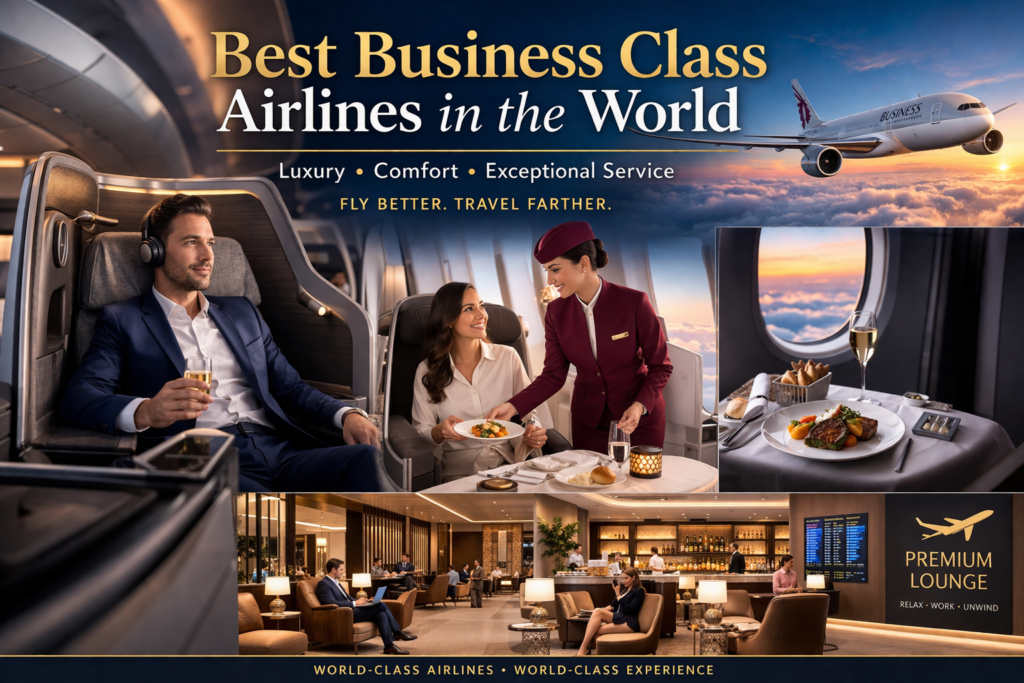
Why Business Class Matters More Than Ever in 2026
The modern business class airline is no longer just a nicer seat with better food. In 2026, it has become one of the clearest battlegrounds in premium travel, where airlines compete through lie-flat seats, business class suites, airport lounges, priority services, fine dining, sleep comfort, and increasingly private cabin design. That matters because premium travelers are not only buying transport. They are buying time, productivity, rest, privacy, and a smoother long-haul experience. In practical terms, a strong business class product can turn a draining international trip into something that actually feels efficient and civilized. That is exactly why best business class airlines, luxury air travel, premium cabin reviews, business class seats, and world’s best airlines remain high-value SEO topics with strong advertiser appeal.
The broader aviation market supports that relevance. IATA’s Q4 2025 Air Transport Chartbook reported that international passenger traffic grew strongly by 8.0% year over year, while premium-class demand also rose, even if economy growth slightly outpaced it in that period. Earlier IATA reporting for Q2 2025 also noted that Middle Eastern carriers saw an 8.8% surge in business-class travel, showing that demand for premium cabins remained meaningful across key global networks. In other words, travelers are still flying, still paying for premium experiences, and still rewarding airlines that make the hardest parts of long-haul travel feel easier. That is why the business class conversation is not a niche one. It sits right at the center of modern premium travel behavior.
What Actually Makes a Great Business Class Airline
A great business class product is built on two layers: the hard product and the soft product. The hard product is the physical side of the experience. That includes the seat, storage, privacy, direct aisle access, bed length, cabin layout, inflight entertainment, and how well the cabin supports sleep and personal space. The soft product is the human and service side. That includes the check-in process, lounge experience, catering, beverage program, cabin crew performance, bedding, amenity kits, and the consistency of the service flow. The best airlines understand that premium travelers need both. A seat can look stunning in photos, but if the service feels disorganized, the experience loses its edge.
This is one reason award systems matter. SKYTRAX’s 2025 business class awards break the category into sub-components like Best Business Class Airline Seats, Best Business Class Onboard Catering, Best Business Class Lounges, and Best Business Class Comfort Amenities. That structure reflects a useful truth: no airline wins business class solely because of one flashy feature. The leaders tend to perform well across the entire chain of the journey, from airport to arrival. Qatar Airways topped SKYTRAX’s 2025 list for the World’s Best Business Class Airlines, while also ranking first for Best Business Class Airline Seats and second for both catering and comfort amenities. That kind of cross-category strength is exactly what defines a world-class premium product.
The Most Trusted Rankings Shaping Business Class in 2025 and 2026
For travelers trying to identify the best business class airlines in the world, two of the most useful public signals right now come from SKYTRAX and AirlineRatings. SKYTRAX’s 2025 results placed Qatar Airways at No. 1 for the World’s Best Business Class Airlines, followed by Singapore Airlines, ANA All Nippon Airways, Cathay Pacific Airways, and Air France in the top five. The top 10 also included Hainan Airlines, STARLUX Airlines, Japan Airlines, Turkish Airlines, and Virgin Atlantic. That ranking is particularly helpful because it is narrowly focused on the cabin itself rather than overall airline prestige alone.
AirlineRatings reached a similar conclusion in its 2025 cabin class awards, where it again named Qatar Airways the best business class airline and pointed specifically to the Qsuite, its enclosed 1-2-1 layout and flexible “bed for two” configuration for some paired seats. That overlap between major ranking systems is important. It suggests that Qatar’s leadership is not just a matter of brand reputation. It reflects a product that multiple evaluators continue to view as setting the benchmark. AirlineRatings also singled out Singapore Airlines in separate editorial coverage, noting that its business class continues to reinforce the airline’s reputation for strong service and a polished long-haul experience.
At the same time, broader airline quality and operational consistency still matter. SKYTRAX’s World’s Top 100 Airlines 2025 ranked Qatar Airways first overall, followed by Singapore Airlines, Cathay Pacific, Emirates, and ANA. Cirium’s 2025 on-time performance review added another useful layer by emphasizing operational reliability and highlighting the performance gains of major carriers such as Virgin Atlantic, which won Cirium’s inaugural “Most Improved” award after raising its on-time performance significantly in 2025. A premium cabin can be beautiful, but if the operation behind it is weak, the overall value proposition suffers.
Qatar Airways Still Sets the Benchmark for Business Class
If there is one airline that continues to dominate the best business class conversation, it is Qatar Airways. SKYTRAX named it the World’s Best Business Class Airline 2025, and AirlineRatings also placed it at the top of its 2025 cabin class awards. SKYTRAX further ranked Qatar first for Best Business Class Airline Seats and second for onboard catering. AirlineRatings pointed directly to the strengths of the Qsuite, especially its enclosed design and flexibility for couples traveling together.
Why does Qatar keep winning? Because it understands that premium travelers want privacy without losing polish. The Qsuite remains one of the most recognizable business class products in the sky because it pushes the cabin closer to a first-class mindset while retaining business class scale. Sliding privacy doors, direct aisle access, strong bedding, and a refined soft product all help create a premium environment that feels intentionally designed rather than merely upgraded. Qatar also benefits from a strong connecting hub in Doha, where its lounge and transit experience support the premium narrative. In business class, that matters enormously. A seat is not experienced in isolation. It is part of a chain, and Qatar’s chain remains one of the strongest in the world.
Singapore Airlines Remains the Gold Standard for Service and Consistency
While Qatar often dominates the headlines, Singapore Airlines remains one of the most respected names in premium aviation. SKYTRAX ranked it No. 2 in the World’s Best Business Class Airlines 2025 list and also placed it highly across several related subcategories, including seats and lounge catering. AirlineRatings’ editorial review in late 2025 concluded that the airline’s long-haul business class still reinforces its status as one of the finest service-led airlines in the industry.
Singapore Airlines has long built its reputation on consistency, and that is a huge competitive advantage in business class. Some airlines can feel brilliant on their best aircraft and less impressive on older ones. Singapore’s strength is that even when travelers debate specific seat designs, the overall experience usually remains elegant, calm, and highly reliable. The airline’s premium service culture, food presentation, and cabin professionalism help it stay near the top year after year. If Qatar feels like the benchmark for private-suite innovation, Singapore often feels like the benchmark for refined, dependable execution. For many travelers, that kind of consistency is even more valuable than novelty.
ANA, Cathay Pacific, and Air France Prove There Is More Than One Path to Excellence
The next tier of elite business class airlines is especially interesting because it shows that there is no single formula for premium success. ANA All Nippon Airways ranked No. 3 in SKYTRAX’s 2025 business class list and also placed No. 2 in Best Business Class Airline Seats 2025, which tells you immediately that seat quality is one of its major strengths. Cathay Pacific ranked No. 4 overall and also performed strongly in categories tied to lounge excellence and comfort. Air France came in fifth overall, showing how a premium European carrier with a strong culinary identity can still compete at the very top.
What makes this trio so compelling is that each airline represents a different premium travel personality. ANA often appeals to travelers who value precision, seat design, and Japanese service discipline. Cathay Pacific tends to attract those who want understated luxury, smart cabin ergonomics, and one of the world’s most respected hub experiences in Hong Kong. Air France appeals to travelers who prioritize style, dining, and the emotional value of a premium European onboard experience. This diversity matters because “best” in business class is partly personal. The leaders all solve the same problem, but in slightly different languages.
Rising Premium Stars: STARLUX, Japan Airlines, Turkish Airlines, and Virgin Atlantic
One of the most interesting parts of the 2025 rankings is the presence of newer or resurgent premium contenders. STARLUX Airlines ranked No. 7 in SKYTRAX’s World’s Best Business Class Airlines 2025 and also placed strongly in categories for seats, catering, and comfort amenities. AirlineRatings later described STARLUX’s A350 business class as design-focused and genuinely competitive with established premium players. That kind of momentum suggests the airline is no longer just an interesting newcomer. It is becoming a serious benchmark for modern premium cabin design.
Japan Airlines, Turkish Airlines, and Virgin Atlantic also deserve attention. Japan Airlines ranked No. 8 overall and No. 3 for Best Business Class Airline Seats 2025, which reinforces its growing reputation for hard-product quality. Turkish Airlines, at No. 9, remains a strong option for travelers who value network breadth and a premium hub proposition through Istanbul. Virgin Atlantic ranked No. 10 overall in SKYTRAX’s business class list and then drew additional attention through Cirium’s 2025 operational improvement recognition. That is an important combination. Premium travelers increasingly care not just about glamour but about reliability. A business class seat is most attractive when the schedule behind it is becoming more dependable too.
Best Business Class Airlines by Key Strength
| Key Strength | Leading Airlines | Why They Stand Out |
|---|---|---|
| Private suite design | Qatar Airways, ANA, Japan Airlines | Strong seat privacy, direct aisle access, bed comfort, modern layouts |
| Service consistency | Singapore Airlines, ANA, Cathay Pacific | Polished cabin crew, calm execution, high service reliability |
| Lounge and transit experience | Qatar Airways, Cathay Pacific, Singapore Airlines, Turkish Airlines | Strong hubs and premium pre-flight environments |
| Dining and catering | Qatar Airways, Singapore Airlines, Air France, Hainan Airlines | Strong onboard meals, refined presentation, premium soft product |
| Emerging luxury momentum | STARLUX Airlines, Virgin Atlantic, Japan Airlines | Growing recognition for modern cabins and stronger operational reputations |
This table shows why choosing the best business class airline is rarely about one metric alone. An airline might dominate in seat design but be merely good in catering. Another might not have the most private suite, yet outperform rivals in service warmth and lounge quality. Premium travelers need to decide what matters most on their specific route. A redeye flight may make sleep and privacy the top priority. A daytime long-haul may make food, workspace, and service flow more important. The smartest travelers do not ask only who is ranked first. They ask which airline best matches the kind of flight they are about to take.
How to Choose the Right Business Class Airline for Your Trip
The right business class airline depends heavily on route, aircraft type, and personal priorities. This is where many travelers get caught. They assume that an airline’s reputation is enough, but business class can vary significantly even within the same carrier depending on the aircraft and cabin generation. SKYTRAX’s sub-awards for seats, catering, lounges, and comfort amenities are useful because they remind travelers to think in components. A traveler who wants maximum privacy may prioritize Qatar, ANA, or Japan Airlines based on seat rankings. A traveler who values service style and reliability may lean toward Singapore Airlines. Someone connecting through a major premium hub may weigh lounge experience more heavily and therefore look closely at carriers like Qatar, Cathay, or Turkish.
There is also a practical budgeting angle. Business class pricing can vary dramatically by route, hub, competition, and season. The best premium travelers think strategically. They look for routes where strong carriers face competition, where newer aircraft are deployed consistently, and where the total journey experience justifies the fare. In business class, value is not just about getting the cheapest flat bed. It is about buying the smoothest, most restorative journey possible for the money. That is why the best booking decision often comes from aligning fare, aircraft, route timing, and personal preference rather than chasing a generic headline ranking.
Why Business Class Still Matters to High-Value Travel Content
From an SEO standpoint, best business class airlines is one of the strongest aviation content categories because it sits at the intersection of luxury, practicality, and purchase intent. Readers searching this topic are often actively planning a long-haul trip, comparing fares, selecting loyalty strategies, or deciding whether to upgrade. That puts the keyword cluster close to major advertiser categories such as premium credit cards, luxury travel insurance, international business travel, airline loyalty programs, and high-end booking platforms. In content terms, it is not just aspirational. It is commercially actionable.
It also performs well because the subject is naturally comparison-driven. Travelers want lists, rankings, seat differences, catering breakdowns, and real reasons to choose one airline over another. That creates strong engagement and longer reading time. A traveler may arrive looking for “the best” and stay to compare products across multiple airlines and routes. That depth of interest makes business class content especially powerful for publishers targeting premium travel traffic, because the reader is not casually browsing. Very often, they are close to a spending decision.
Conclusion
The best business class airlines in the world in 2025 and heading into 2026 are the ones that combine seat quality, privacy, service consistency, premium catering, and lounge experience into one seamless product. Based on current major rankings, Qatar Airways remains the clearest overall benchmark, supported by both SKYTRAX and AirlineRatings. Singapore Airlines continues to define polished service and reliability. ANA, Cathay Pacific, and Air France prove that several different premium philosophies can still produce elite results, while STARLUX, Japan Airlines, Turkish Airlines, and Virgin Atlantic add compelling alternatives depending on the traveler’s priorities.
The smartest way to choose among them is not to obsess over a single universal winner. It is to decide what matters most on your specific journey. Do you want a private suite, the best sleep, elegant food, a better lounge, smoother operations, or a more refined service style? Once you answer that, the right business class airline often becomes clear. The best premium cabin is not always the one with the loudest marketing. It is the one that makes your long-haul trip feel like time well spent instead of time merely endured.
FAQs
1. Which airline currently has the best business class in the world?
Based on both SKYTRAX 2025 and AirlineRatings 2025, Qatar Airways is the leading current benchmark for business class.
2. Which airline has the best business class seats?
Qatar Airways ranked first in SKYTRAX Best Business Class Airline Seats 2025, followed by ANA and Japan Airlines.
3. Is Singapore Airlines still one of the best for business class?
Yes. Singapore Airlines ranked No. 2 in SKYTRAX’s World’s Best Business Class Airlines 2025 and continues to be praised for service quality and overall consistency.
4. Are newer airlines like STARLUX really competitive in business class?
Yes. STARLUX Airlines ranked No. 7 in SKYTRAX’s 2025 business class list and has drawn praise for its refined A350 premium cabin design.
5. Does reliability matter when choosing a business class airline?
Absolutely. Premium travelers benefit most when a strong cabin product is backed by solid operational performance, which is why sources like Cirium add useful context beyond cabin awards alone.