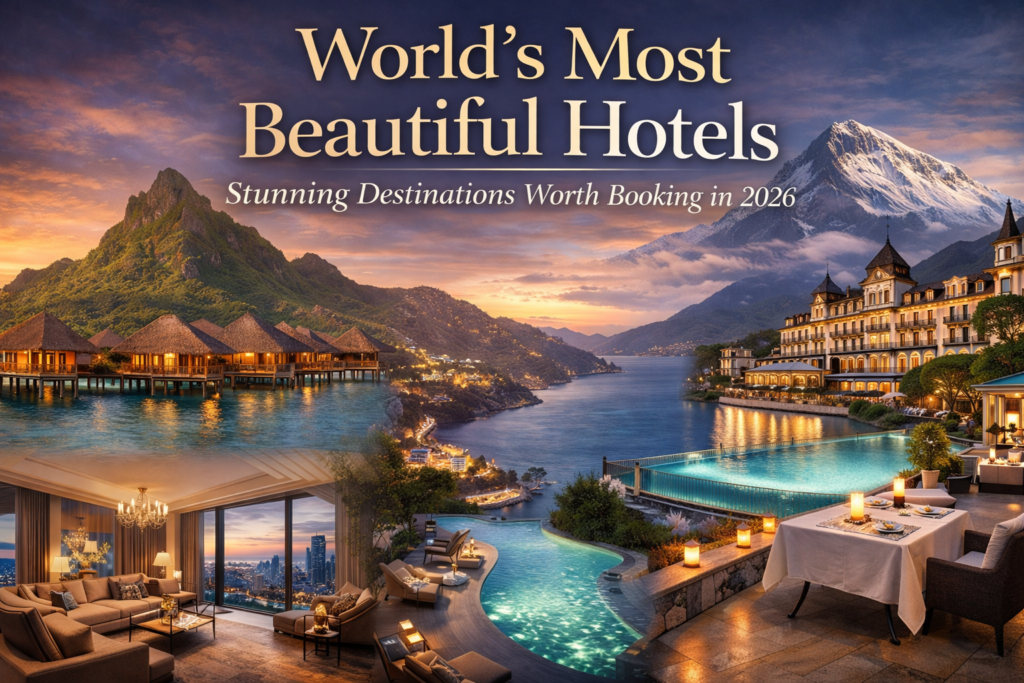
Why Beautiful Hotels Matter More Than Ever in Luxury Travel
The idea of a beautiful hotel used to be simple. Travelers looked for a grand lobby, elegant suites, a photogenic pool, and maybe a dramatic ocean view. In 2026, that definition is far more sophisticated. The world’s most desirable hotels now combine architectural beauty, luxury hospitality, wellness design, private experiences, and destination storytelling into one seamless product. Beauty is no longer just visual. It is emotional, immersive, and highly marketable, which is exactly why luxury travel, five-star hotels, premium resorts, private villas, and exclusive vacation experiences continue to attract high-value advertising categories. At the same time, global travel demand remains strong. UN Tourism reported that international tourist arrivals rose 4% in 2025 to an estimated 1.52 billion, showing that premium travel appetite is still very much alive.
That shift matters because today’s luxury traveler is not booking a hotel only for a bed and breakfast. They are booking a setting, a mood, a personal fantasy, and sometimes even a status symbol. A truly beautiful hotel can shape the entire trip the way a great soundtrack shapes a film. Remove it, and the journey feels flatter. Keep it, and every moment seems richer. This is why world’s most beautiful hotels, luxury resort destinations, iconic five-star hotels, and best hotels in the world 2026 are such powerful SEO terms. They capture travelers who are ready to spend, compare, and dream at the same time. In that sense, beauty in hospitality is not a decorative bonus. It is a core value driver.
What Makes a Hotel Truly Beautiful in 2026
A beautiful hotel today has to do more than look expensive. It needs a clear identity. Some properties win through dramatic architecture, while others create beauty through privacy, local craftsmanship, or a near-perfect relationship with the surrounding landscape. The strongest luxury hotels feel as though they belong to their destination while still elevating it. That could mean a cliffside property that appears carved from the earth, a historic palace hotel restored with breathtaking restraint, or an overwater retreat where the horizon becomes part of the room. This is where modern hotel design, luxury interiors, destination architecture, and boutique hospitality all start to overlap.
Independent hotel benchmarks reinforce that idea. Forbes Travel Guide says it rates luxury properties through anonymous inspections using up to 900 objective standards, with service remaining central to the experience. That matters because even the most beautiful resort can feel empty if the service is clumsy or impersonal. The MICHELIN Guide takes a similar quality-first approach to hotel recognition through its Key system, which identifies very special, exceptional, and extraordinary stays. In other words, beauty alone is not enough. The best hotels combine aesthetics with comfort, privacy, precision, and emotional impact. A gorgeous hotel that fails at hospitality is like a supercar with a weak engine. It looks stunning, but the real performance is missing.
The Global Hotel Rankings Shaping Luxury Travel Right Now
When travelers ask which hotels are the most beautiful in the world, the answer depends partly on the lens being used. Some rankings reward visual impact, some reward service quality, and others reward overall memorability. One of the strongest current references is The World’s 50 Best Hotels 2025, which placed Rosewood Hong Kong at No. 1, followed by Four Seasons Bangkok at Chao Phraya River at No. 2 and Capella Bangkok at No. 3. The rest of the top 10 included Passalacqua, Raffles Singapore, Atlantis The Royal, Mandarin Oriental Bangkok, Chablé Yucatán, Four Seasons Firenze, and Upper House Hong Kong. That list is valuable because it reflects not just old-school prestige, but the properties that are generating the strongest global admiration right now.
The list also reveals something bigger about where hotel beauty is heading. Asia remains dominant, with Hong Kong, Bangkok, Singapore, and Beijing all commanding serious attention. At the same time, Europe continues to lead in heritage grandeur, while the Middle East stands out for scale, spectacle, and ultra-modern luxury. Special category awards from the same platform add even more texture: Soneva Fushi won the Art of Hospitality Award in 2025, Mandarin Oriental Qianmen, Beijing was recognized as Best New Hotel, Desa Potato Head, Bali earned the Eco Hotel Award, and Atlantis The Royal, Dubai received the Best Beach Hotel title. That combination shows that beauty today can mean classic elegance, sustainable creativity, or futuristic glamour, depending on the traveler’s taste.
Asia’s Most Beautiful Hotels Are Setting the Global Pace
If one region is defining hotel beauty at the highest level right now, it is Asia. That is not just a matter of ranking positions. It reflects a deeper advantage in hospitality culture, design confidence, and service sophistication. Rosewood Hong Kong, the current No. 1 on The World’s 50 Best Hotels list, represents a particularly modern kind of beauty. It is grand, polished, and urban, yet it also feels emotionally precise, which is rare in very large luxury properties. Four Seasons Bangkok at Chao Phraya River and Capella Bangkok prove that city hotels can still feel calm and visually transporting when they are designed around water, light, and intimacy rather than pure scale.
This regional strength is not accidental. Many leading Asian hotels excel at combining architecture with service choreography. The result is a guest experience that feels composed rather than simply decorated. Walk into one of these properties and the atmosphere often feels like a perfectly directed film scene where every detail has been edited for emotional effect. That includes the fragrance in the lobby, the room’s layout, the ratio of privacy to openness, and even the flow between dining, spa, and suite. Travelers searching for luxury hotels in Asia, best hotels in Hong Kong, Bangkok riverfront hotels, or most beautiful city hotels are really searching for this rare blend of sensory beauty and operational polish. That is why Asia is not just participating in the conversation. It is leading it.
Europe Still Owns Timeless Grand Hotel Beauty
Asia may be dominating many current rankings, but Europe still holds unmatched power when it comes to classic elegance and historic romance. Passalacqua on Lake Como remains one of the strongest examples of a hotel that feels almost impossibly cinematic. It is not simply luxurious. It is atmospheric, intimate, and emotionally rich in a way that many newly built properties cannot replicate. Four Seasons Firenze operates in a similar realm, combining Renaissance-era grandeur with the technical comfort expected from a top-tier modern luxury stay. These hotels prove that timeless beauty often comes from heritage, proportion, and restraint rather than flash.
The appeal of Europe’s most beautiful hotels lies in their ability to make travelers feel like they are stepping into another era without sacrificing present-day convenience. A well-restored palace hotel or lakeside villa does not just provide accommodation. It offers atmosphere with memory attached. Walls, gardens, staircases, and suites feel layered with history, which creates a kind of beauty no amount of new money can instantly build. That is why luxury hotels in Italy, best hotels in Florence, romantic European hotels, and historic five-star hotels remain some of the strongest search categories in global hospitality. They promise not just comfort, but character.
The Middle East and Island Resorts Deliver Spectacle and Escape
Beauty in luxury hospitality does not always whisper. Sometimes it arrives like fireworks reflected in a private infinity pool. This is where the Middle East and top island resorts play a powerful role. Atlantis The Royal in Dubai, which earned The World’s 50 Best Hotels 2025 Best Beach Hotel award, represents one of the clearest expressions of ultra-modern spectacle. It is bold, lavish, and intentionally unforgettable. For travelers who want scale, visual drama, celebrity-level amenities, and a stay that feels almost surreal, that kind of property is hard to ignore.
On the other end of the emotional spectrum, island icons such as Soneva Fushi show that beauty can also come through serenity, simplicity, and environmental intimacy. Rather than impressing through monumental design alone, these resorts create beauty by dissolving boundaries between architecture and nature. Sand, sea, sky, wood, and light become part of the room itself. This is why private island resorts, luxury beach villas, eco-luxury hotels, and honeymoon resorts continue to perform so well in premium travel marketing. The guest is not just buying a room with a good view. They are buying a temporary alternative reality, one designed to feel quieter, softer, and more restorative than ordinary life.
Sustainability and Design Are Becoming Beautiful Together
One of the most interesting developments in luxury travel is that beauty and sustainability are no longer being treated as opposing ideas. In fact, some of the most visually compelling properties today are also the ones building stronger environmental narratives. Desa Potato Head, Bali receiving the 2025 Eco Hotel Award is a useful symbol of this shift. It suggests that the market now values hotels that can be aesthetically striking and environmentally thoughtful at the same time. That is a major change from older luxury models that often equated beauty with visible excess.
This change is commercially important as well as culturally important. Affluent travelers increasingly want sustainable luxury hotels, eco-friendly resorts, wellness travel, and responsible hospitality without feeling that they are compromising on comfort or style. Forbes Travel Guide’s broader luxury positioning and MICHELIN’s expansion of hotel recognition both support this more sophisticated view of excellence. A hotel can now be aspirational because it is beautifully designed, intelligently run, and ethically aware. That makes the modern luxury hotel feel less like a trophy and more like a well-made living environment. In 2026, that combination is becoming one of the most attractive selling points in the industry.
How to Choose the Most Beautiful Hotel for Your Travel Style
Not every beautiful hotel is beautiful for the same reason, which is why choosing the right one starts with understanding your own travel identity. Some travelers want romantic luxury hotels with privacy, warm lighting, spa rituals, and dreamy views. Others want best city luxury hotels with architectural prestige, elite restaurants, and fast access to shopping or business districts. Families may prefer luxury resorts with larger suites, multiple pools, and polished service that can handle logistics gracefully. Wellness travelers may care more about calm, space, natural materials, and slow rhythms than grand chandeliers or iconic branding. Beauty is highly personal, and that is exactly why hotel selection should be strategic rather than impulsive.
A useful way to think about it is to treat a hotel as the emotional frame of the trip. A dramatic urban tower can feel perfect for a celebration weekend, yet totally wrong for someone craving silence and recovery. A remote island villa can be heaven for one traveler and boredom for another. That is why a ranking should be the beginning of research, not the end of it. The smartest travelers do not ask only which property is most famous. They ask which property tells the story they want to live for a few days. Once that question becomes clear, the right hotel often becomes obvious.
Luxury Booking Trends That Matter in 2026
The timing of a booking matters almost as much as the hotel itself. Global demand remains strong, and that means many top properties continue to enjoy pricing power, especially during festive periods, school holidays, and peak destination seasons. UN Tourism’s 2025 data supports this broader environment of sustained travel demand, which in turn reinforces premium pricing across sought-after markets. Travelers targeting the world’s most beautiful hotels in 2026 should expect competition for the best room categories, villa inventory, and view-driven suites.
That does not mean luxury travelers should simply spend blindly. It means they should spend intentionally. Shoulder seasons can still offer incredible value, especially when the destination remains visually beautiful outside absolute peak dates. Room category selection also matters. Sometimes the leap from a standard room to a junior suite barely changes the experience, while in other cases the jump to a villa or terrace suite completely transforms it. Smart luxury booking is less about saving every dollar and more about aiming money at the features that will genuinely improve the stay. In that sense, booking a top hotel is like commissioning a tailored suit. The details determine whether it merely fits or feels exceptional.
Comparison Table: Beautiful Hotels by Experience Type
| Experience Type | Standout Current Examples | Best For |
|---|---|---|
| Urban architectural luxury | Rosewood Hong Kong, Upper House Hong Kong | Skyline views, design-led city stays, premium service |
| Riverfront elegance | Four Seasons Bangkok, Capella Bangkok, Mandarin Oriental Bangkok | Calm city luxury, dining, romantic escapes |
| Historic European grandeur | Passalacqua, Four Seasons Firenze, Raffles Singapore | Heritage charm, timeless interiors, classic prestige |
| Spectacle-driven resort glamour | Atlantis The Royal | Big-impact luxury, beach leisure, bold modern design |
| Nature-led barefoot beauty | Soneva Fushi, Chablé Yucatán | Wellness, privacy, landscape immersion |
| Eco-conscious creative hospitality | Desa Potato Head, Bali | Sustainable luxury, design, modern lifestyle travel |
The table makes one thing clear: beauty in hospitality is not one category. It is a spectrum. Some travelers want the clean precision of a high-rise sanctuary above the harbor. Others want gardens, silence, and the softness of a historical estate. Some want show-stopping scale and contemporary drama. Others want a property that feels like it was hidden from the world on purpose. The right choice depends on whether you are chasing energy, serenity, heritage, design, or escape.
That is also why the global hotel market remains so fascinating from an SEO and advertising perspective. A traveler searching best luxury city hotels, most beautiful beach resorts, romantic boutique hotels, or five-star eco hotels may all be looking for beauty, but they are using completely different emotional filters. Good content has to recognize those distinctions. Great hotel selection does too.
Conclusion
The world’s most beautiful hotels in 2026 are not just visually impressive properties with expensive finishes. They are destinations that combine luxury design, five-star service, cultural atmosphere, wellness appeal, and memorable emotional impact into a complete travel experience. Current hotel benchmarks show a clear pattern. Asia is setting the pace with extraordinary city properties like Rosewood Hong Kong, Four Seasons Bangkok, and Capella Bangkok. Europe continues to dominate timeless grandeur through names like Passalacqua and Four Seasons Firenze. The Middle East and top island resorts add a different language of beauty through spectacle, privacy, and immersion.
The smartest way to book a beautiful hotel is to stop asking for a universal winner and start asking what kind of beauty fits your trip. Do you want architectural drama, romantic heritage, tropical stillness, or urban prestige? Do you want a hotel that feels like a museum, a sanctuary, a cinematic fantasy, or a private hideaway? The answer shapes everything. The best luxury hotel is not always the one with the loudest reputation. It is the one that turns the destination into something personal, unforgettable, and worth returning to in your mind long after checkout.
FAQs
1. Which hotel is considered the most beautiful in the world right now?
There is no single universal answer, but Rosewood Hong Kong currently holds the No. 1 position on The World’s 50 Best Hotels 2025, making it one of the strongest contenders in the global conversation.
2. Are beautiful hotels always the most expensive hotels?
Not necessarily. Many of the most beautiful hotels are expensive, but beauty can come from design, setting, heritage, or intimacy rather than pure price alone. Some boutique or nature-led properties feel more special than larger ultra-luxury chains.
3. Which region has the most beautiful luxury hotels in 2026?
Asia has some of the strongest momentum right now, especially Hong Kong, Bangkok, Singapore, Bali, and Beijing, based on major current rankings and awards.
4. What are MICHELIN Keys in hotels?
MICHELIN Keys are hotel distinctions from The MICHELIN Guide that identify outstanding stays, with one, two, and three Keys representing increasing levels of excellence.
5. Is 2026 a good year to book luxury hotels?
Yes. Strong global tourism demand in 2025 indicates that premium travel remains active, so 2026 is a strong year for luxury travel, though top hotels may require earlier booking for the best availability.